How Much Should You Really Feed Your Cat? Debunking the “Free Feeding” Habit

This cat feeding guide moves beyond the bag’s suggested amount — there is no single number of grams or calories that is correct for every cat. A practical feeding plan starts with the cat’s life stage, body size, activity, body condition, the calorie density of the food, and how the cat responds over time.
If you are starting with the basics of feline nutrition, see Essential Nutrients for Cats before deciding how much food to offer.
Why the feeding guide on the bag is only a starting point
The feeding guide on a pet-food package is useful because it gives owners a practical starting point. But it cannot account for every individual cat. Two cats of the same weight can have different energy needs because of activity level, age, reproductive status, body condition, and other individual factors.
WSAVA describes calorie estimates as starting points rather than universal prescriptions. The amount should be adjusted according to the individual animal’s response and body condition.
For a refresher on food-label information, read how to read a pet food label.
Calories matter more than cups or cans
A cup, can, pouch, or scoop is not a universal unit of nutrition. Different foods can contain very different amounts of energy in the same volume. The same-sized scoop of two foods may therefore deliver different calories.
When a food provides a calorie value, use it to translate a daily calorie target into an amount of food. For example, if a cat’s starting allowance were 220 kcal per day and the food supplied 400 kcal per 100 g, the mathematical starting amount would be 55 g per day. This is only a starting calculation; the cat’s weight and body condition still determine whether the amount is appropriate.
A simple cat feeding guide: 4 questions to ask
Instead of asking, “How many grams should every cat eat?”, ask four questions:
- What life stage is my cat in?
- What is the calorie density of the food?
- What is my cat’s current body condition and weight trend?
- How much food is my cat actually receiving from meals, treats, and extras?
The goal is not to hit a perfect number once. The goal is to establish a reasonable starting amount, measure it consistently, and adjust when the cat’s body condition or weight trend shows that the amount is not right.
What “free feeding” actually means
Free feeding, or ad libitum feeding, means leaving food available so the cat can eat whenever it chooses. This is different from measuring the cat’s total daily allowance and dividing it into several meals.
Free access is not automatically harmful for every cat, but it can make intake harder to measure. It can also become a problem when a cat eats more calories than it needs, particularly in an indoor lifestyle with limited activity.
Feline veterinary guidance emphasizes multiple small meals and normal hunting and foraging behavior. See how to feed a cat for the behavioral side of feeding.
Measured portions do not mean one giant meal
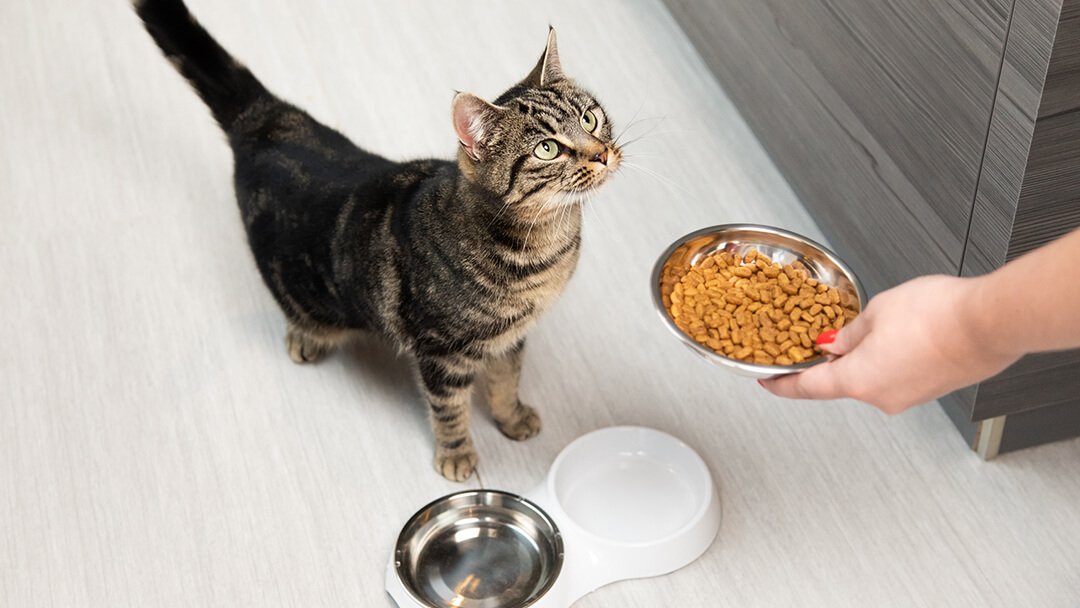
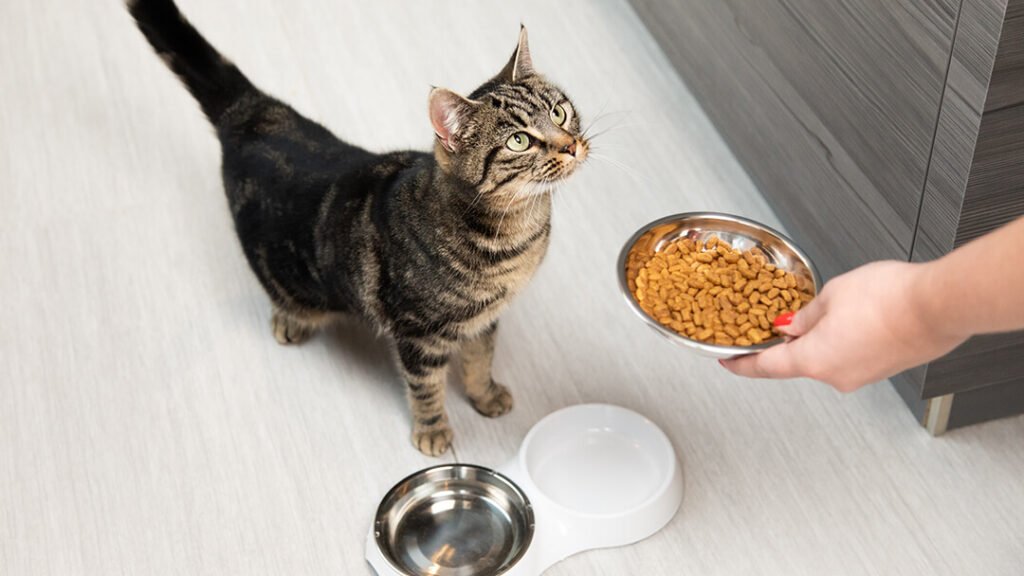
Portion control and natural feeding behavior can work together. Instead of putting the entire daily allowance in one bowl, divide the measured amount into several smaller meals. Puzzle feeders, food-dispensing toys, and strategically placed small portions can add opportunities for movement and foraging.
In multi-cat homes, feeding separately may also make it easier to know who ate what. This matters when one cat is gaining weight, another is losing weight, or one cat has a medical diet.
If you are comparing wet and dry foods, remember that water content changes the amount of food needed by weight and volume. See Wet vs. Dry Cat Food for the comparison.
How to adjust the amount without guessing
Start with the food label and an appropriate calorie estimate, then monitor the cat. Weighing the food with a kitchen scale can be more consistent than using an unmarked scoop. Keep the daily amount stable enough that you can see a trend.
If the cat is gaining unwanted body fat, the daily intake may need to be reduced. If the cat is losing weight without that being intentional, eating poorly, or showing other health changes, do not simply keep cutting or increasing food on your own. A veterinarian can assess the cat and determine whether a medical issue or a different feeding plan is involved.
WSAVA recommends using body condition assessment alongside calorie estimates. A healthy weight is not just a number on the scale; body condition helps show whether the amount being fed is appropriate for the individual cat.
Treats count too
A feeding plan can look correct on paper and still provide too many calories if treats, toppers, table food, or other extras are added without accounting for them. Treat calories should be considered part of the cat’s overall daily intake.
If you use treats for training or enrichment, measure them rather than adding an unlimited amount on top of regular meals.
A practical checklist
- Choose food appropriate for your cat’s life stage.
- Check the food’s calorie density rather than relying only on cups or cans.
- Measure the daily portion consistently.
- Divide the allowance into multiple meals when practical.
- Count treats and extras.
- Monitor weight and body condition rather than assuming the label amount is perfect.
- Reassess the plan when activity, health, appetite, or body condition changes.
- Ask a veterinarian for help if your cat is losing weight unexpectedly, becoming overweight, eating much less, or has a medical condition.
Quick summary
- There is no single feeding amount that fits every cat.
- Food calorie density matters because equal volumes of different foods can provide different calories.
- The package feeding guide is a starting point, not a personalized prescription.
- Measured portions can be divided into several small meals to better fit feline feeding behavior.
- Free feeding can make calorie intake harder to track and may contribute to overeating in some cats.
Weight and body condition are essential reality checks.