How to Read a Pet Food Label: 8 Things to Check

Introduction
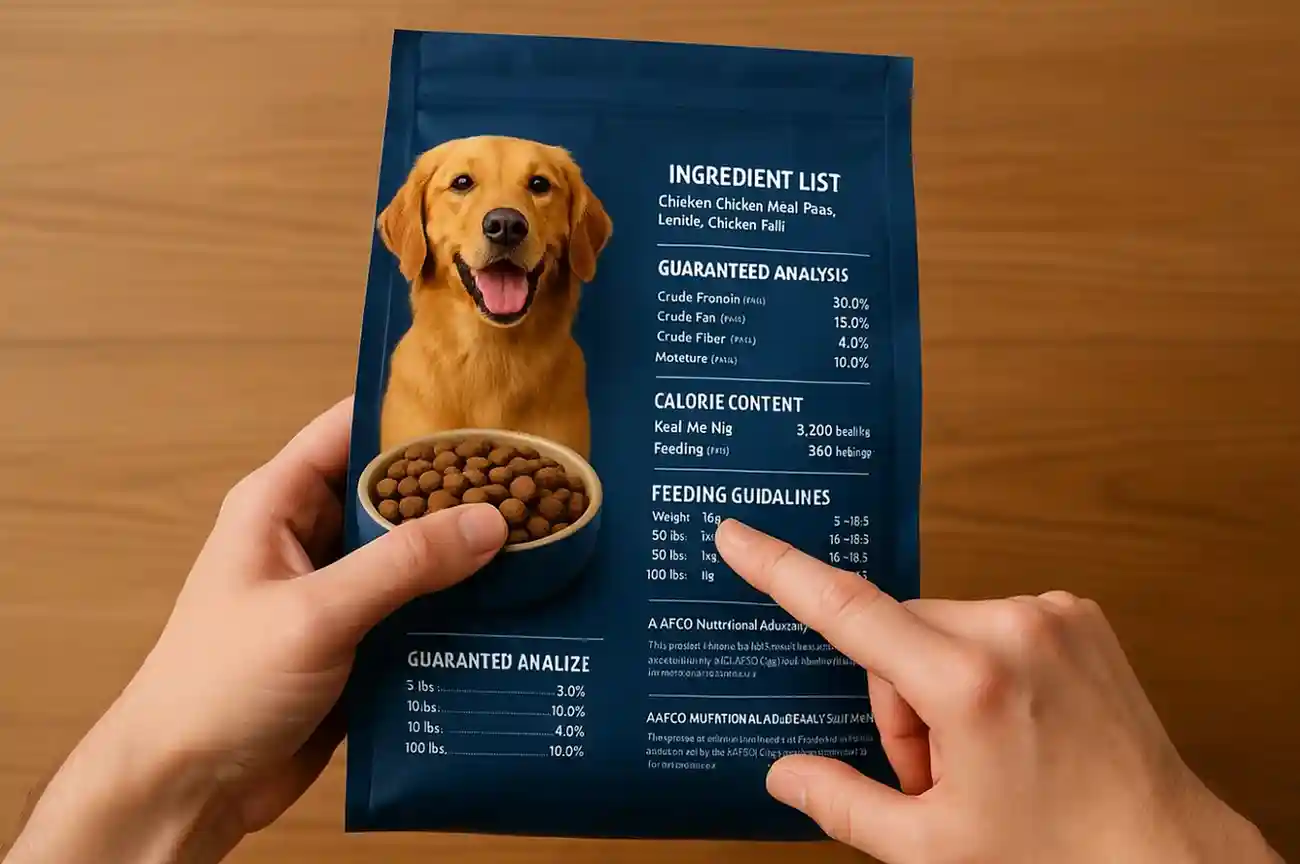
How to read a pet food label can feel confusing when every package uses different ingredients, claims, and numbers. Instead of focusing only on the front of the package, check the information on the back or side to understand what the food actually provides.
Here are 7 things to check when reading a pet food label.
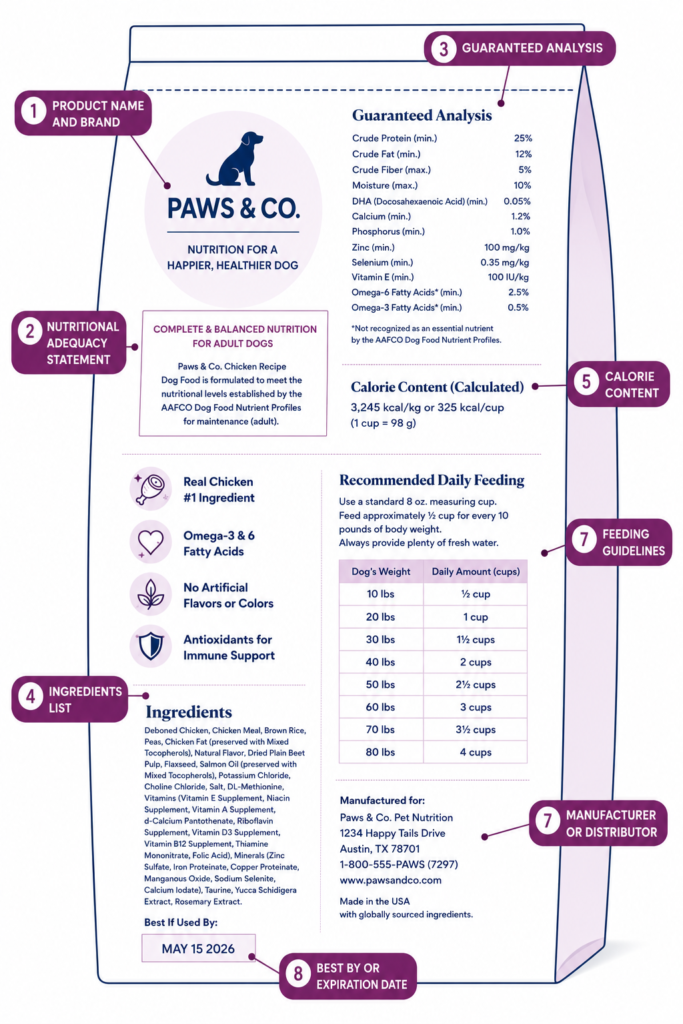
Table of Contents
1. Check the Product Name and Species
Start with the basics: what animal is the food intended for?
A picture of a dog or cat on the package is not enough to establish the intended species. The label should clearly identify whether the product is formulated for dogs, cats, or another type of pet.
Also check the product name and any descriptors carefully.
Look for:
- Dog food or cat food designation
- Product or brand name
- Whether a named ingredient is part of the product name
- Whether the product is a complete food, treat, supplement, or another type of product
This matters because dogs and cats do not have identical nutritional requirements. For example, cats have specific nutritional requirements that differ from those of dogs.
2. Find the Nutritional Adequacy Statement
The nutritional adequacy statement is one of the most useful parts of a pet food label.
Look for wording indicating that the food is complete and balanced for a particular species and life stage.
The statement should tell you:
- Species — dog or cat
- Life stage — such as growth or adult maintenance
- Whether the food is intended to provide complete and balanced nutrition
- The nutritional basis supporting that claim
AAFCO explains that “complete” means the required nutrients are present, while “balanced” refers to those nutrients being provided in appropriate ratios.
For example, a label may state that a product is formulated to meet the nutritional levels established by the relevant AAFCO nutrient profile for adult maintenance.
This section is generally more useful than claims such as “premium” or “natural” when determining whether a food is intended to provide a complete diet.
3. Understand the Guaranteed Analysis
The Guaranteed Analysis provides information about certain nutrient levels in the food.
For most conventional pet foods, the basic guarantees include:
- Crude protein — minimum
- Crude fat — minimum
- Crude fiber — maximum
- Moisture — maximum
Additional nutrients may also appear when they are required or voluntarily guaranteed.
One important point
These percentages are normally reported on an as-fed basis, meaning they include the food’s moisture.
That makes direct comparisons between very different foods difficult. For example, wet food contains substantially more water than dry food, so a lower protein percentage on the label does not automatically mean that the wet food contains less protein relative to its dry matter.
So don’t judge a product simply because its protein percentage is higher.
4. How to Read a Pet Food Label: Check the Ingredient List
The ingredient list shows what goes into the food.
Ingredients are generally listed in descending order by weight, with the ingredients contributing the greatest weight appearing first.
When reading the list, pay attention to:
- The first several ingredients
- Main sources of animal or plant ingredients
- Sources of fat
- Added vitamins and minerals
- Preservatives and other functional ingredients
- Ingredients your pet may need to avoid
However, the first ingredient does not tell you whether the entire food is nutritionally superior.
A pet food is a formulated product. Vitamins, minerals, amino acids, fatty acids, and other ingredients may be included to achieve the required nutritional profile. Knowing how to read a pet food label can help you put the ingredient list into context instead of judging the food by a single ingredient
5. Check the Calorie Content
Look for a section labeled Calorie Content.
AAFCO’s labeling guidance calls for calorie information to be expressed as kilocalories per kilogram of food as fed and also in a familiar unit such as kcal per cup, can, or biscuit.
Calories are useful when comparing foods or adjusting feeding amounts.
For example:
- Food A: 3,200 kcal/kg
- Food B: 3,800 kcal/kg
The same volume of Food B may provide more calories.
However, more calories does not automatically mean better food. Calorie needs depend on factors such as the pet’s size, age, activity level, and individual condition.
6. Follow the Feeding Directions
Feeding directions provide a starting point for deciding how much food to offer.
They may be presented as:
- A feeding table based on body weight
- Daily amounts
- Different recommendations for different life stages
- Instructions for specific types of food
AAFCO notes that feeding directions are guidelines that may need to be adjusted to meet an individual pet’s needs.
For example, two dogs of the same weight may not require exactly the same amount of food if their activity levels and individual needs differ.
If you’re unsure how much your pet should eat, a veterinarian can help determine an appropriate feeding plan.
7. Check the Manufacturer or Distributor
The label should identify the manufacturer, distributor, or responsible company.
This information can help you:
- Identify who is responsible for the product
- Contact the company with questions
- Check product information
- Verify details when comparing products
AAFCO refers to this responsible party as the guarantor.
8. Look at the Best-By or Expiration Date
Finally, check the date information on the package.
A date can help you determine whether the product is within its intended shelf life. Also consider how the food has been stored, particularly after opening.
For opened food, follow the manufacturer’s storage instructions and keep the package properly sealed..
Conclusion
Once you know how to read a pet food label, comparing different products becomes much easier because you can look at the same key information on each package.
Knowing how to read a pet food label makes it easier to compare different products without relying only on packaging claims.
Start with these seven checks:
- Species
- Life stage
- Complete and balanced statement
- Guaranteed analysis
- Ingredient list
- Calories and feeding directions
- Marketing claims
For more guidance, explore our Pet Food page, Dog Nutrition guide, and Cat Nutrition guide.