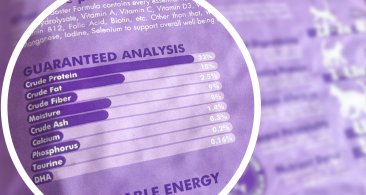
What Is Guaranteed Analysis in Pet Food? A Simple Guide

Introduction
When choosing pet food, the ingredient list is not the only part of the label worth reading. Another important section is the Guaranteed Analysis.
Guaranteed Analysis provides information about certain nutrients in a pet food product. It can help you understand the basic nutritional composition of the food and make more informed comparisons between products.
However, the numbers can be easy to misunderstand.
A food showing 30% protein is not automatically better than one showing 25% protein. Moisture content, food type, life stage, calories, and the rest of the nutritional profile all matter.
In this guide, we’ll explain what Guaranteed Analysis means and how to use it when comparing pet foods. For a broader explanation of the different sections of a pet food label, see our How to Read a Pet Food Label guide.
Table of Contents
What Is Guaranteed Analysis?
Guaranteed Analysis is the section of a pet food label that states guaranteed amounts of certain nutrients.
For conventional pet foods, the basic guarantees generally include:
- Crude protein — minimum
- Crude fat — minimum
- Crude fiber — maximum
- Moisture — maximum
Other nutrients may also appear when they are required or voluntarily guaranteed on the label.
The word “crude” does not mean the ingredient is poor quality. It refers to the analytical method used to measure the nutrient category. For example, crude protein is determined using an analytical method based on nitrogen content.
1. Crude Protein
What it tells you
Crude protein represents the minimum amount of protein guaranteed in the food.
Protein provides amino acids that dogs and cats use for functions such as:
- Maintaining muscles
- Supporting tissue repair
- Producing enzymes and hormones
- Supporting normal body functions
To learn more about the role of protein, fats, carbohydrates, vitamins, and minerals in a dog’s diet, see our guide to What Dogs Need in Their Diet.
But more protein does not automatically mean better food. When evaluating protein, also consider:
- Your pet’s life stage
- The overall nutritional profile
- The food’s calorie density
- Whether the food is intended to be complete and balanced
- The source and quality of the protein
Important: “minimum” matters
If a label says:
Crude Protein — 25% min
25% is a minimum guarantee, not necessarily the exact amount in every batch.
AAFCO explains that guaranteed values are set as minimums or maximums because nutrient composition can vary between production batches.
2. Crude Fat
What it tells you
Crude fat is listed as a minimum guaranteed percentage. Fat is an important source of energy and also contributes fatty acids that have roles in normal biological functions. When comparing foods, don’t look at fat percentage alone.
A higher-fat food may provide substantially more calories per gram than a lower-fat food. Therefore, two foods with similar protein percentages can provide different amounts of energy depending on their fat content and overall formulation.
Look at these together:
| Label information | What to consider |
|---|---|
| Protein | Minimum protein level |
| Fat | Minimum fat level |
| Calories | Energy provided by the food |
| Moisture | How much water the food contains |
| Life stage | Whether the food is designed for your pet’s stage of life |
3. Crude Fiber
Crude fiber is generally listed as a maximum, rather than a minimum. Fiber is associated with digestive function and can contribute to stool characteristics and intestinal health. However, the crude fiber number should not be treated as a complete measurement of all dietary fiber in a food. So if one food says:
Crude Fiber — 4% max
and another says:
Crude Fiber — 6% max
you shouldn’t conclude that the first food is automatically healthier.
The type and amount of fiber, the rest of the formulation, and the individual needs of the pet also matter.
4. Moisture
Moisture is particularly important when comparing dry food with wet or canned food. If you’re comparing wet and dry cat food specifically, see our [Wet vs. Dry Cat Food: Which Is Better for Your Cat?] guide.
For example, a dry food may contain around 10–12% moisture, while canned food can contain substantially more water. FDA notes that canned pet food is typically around 75–78% moisture, compared with around 10–12% for dry pet food.
This creates an important problem:
You cannot always compare protein percentages directly.
Imagine:
| Nutrient | Dry Food | Wet Food |
|---|---|---|
| Protein | 30% | 10% |
| Moisture | 10% | 78% |
At first glance, the dry food appears to have much more protein.
But the wet food contains much more water, so the percentages are being expressed on a different moisture basis.
This is why comparing foods with very different moisture levels may require converting the numbers to a dry matter basis.
How to Compare Pet Food on a Dry Matter Basis
The basic calculation is:
Dry Matter % = 100 − Moisture %
Then:
Nutrient % on dry matter basis = Nutrient % ÷ Dry Matter % × 100
Example
Suppose a wet food contains:
- Protein: 10%
- Moisture: 78%
First calculate dry matter:
100 − 78 = 22%
Then calculate protein on a dry matter basis:
10 ÷ 22 × 100 = 45.5%
So the food’s protein content is approximately 45.5% on a dry matter basis.
This doesn’t mean you should use protein percentage alone to choose a food. It simply gives you a more meaningful way to compare nutrient concentrations between foods with different moisture levels. FDA provides the same dry-matter conversion approach when comparing pet foods.
Guaranteed Analysis vs. Ingredient List
These two sections answer different questions.
Ingredient List
Tells you:
What ingredients are used?
Ingredients are generally listed in descending order by weight.
Guaranteed Analysis
Tells you:
What amounts of certain nutrients are guaranteed?
Therefore, you should look at both rather than relying on either section alone.
For example:
Ingredient list
- Chicken
- Chicken meal
- Brown rice
- Peas
- Chicken fat
Guaranteed Analysis
- Crude Protein: 26% min
- Crude Fat: 14% min
- Crude Fiber: 4% max
- Moisture: 10% max
The ingredient list helps you understand the ingredients used, while the Guaranteed Analysis provides information about certain nutrient levels.
What Guaranteed Analysis Does Not Tell You
This is one of the most important points. Guaranteed Analysis does not tell you everything about the nutritional quality of a food. It doesn’t, by itself, tell you:
- Whether the food is appropriate for your pet’s life stage
- The complete amount of every essential nutrient
- The quality or digestibility of every ingredient
- Whether the food meets the appropriate nutritional adequacy standard
- How many calories your pet actually needs each day
That’s why you should also check the nutritional adequacy statement, feeding directions, calorie information, and ingredient list. AAFCO identifies these as separate parts of pet food labeling.
5 Things to Check on a Pet Food Label
When evaluating a food, use Guaranteed Analysis as one part of the process. Our guide on How to Choose Pet Food explains how to consider these factors together when selecting a food for your pet.
① Check the life stage
Is the food intended for:
- Growth?
- Adult maintenance?
- All life stages?
② Read the Guaranteed Analysis
Check:
- Protein
- Fat
- Fiber
- Moisture
- Any additional guarantees
③ Check the calorie content
Two foods with similar nutrient percentages can provide different amounts of energy.
④ Read the ingredient list
Look beyond the first ingredient and consider the overall formulation.
⑤ Check the nutritional adequacy statement
Look for information indicating what species and life stage the food is formulated to support.
Can You Choose Pet Food by Protein Percentage Alone?
No. Protein percentage is useful information, but it should not be the only factor.
A better approach is to consider:
- Protein and fat levels
- Moisture
- Calorie density
- Life stage
- Nutritional adequacy
- Ingredient list
- Your pet’s individual needs
For example, comparing a dry food containing 30% protein with a wet food containing 10% protein without accounting for moisture can give you a misleading impression.
Quick Guide to Guaranteed Analysis
| Guaranteed Analysis | Usually expressed as | What it tells you |
|---|---|---|
| Crude Protein | Minimum | Guaranteed minimum protein level |
| Crude Fat | Minimum | Guaranteed minimum fat level |
| Crude Fiber | Maximum | Maximum guaranteed crude fiber |
| Moisture | Maximum | Maximum guaranteed moisture |
| Other nutrients | Varies | Additional nutrient guarantees when applicable |
Conclusion
Guaranteed Analysis is a useful starting point for understanding pet food, but it should not be used by itself to decide which food is best.
Start by checking the protein, fat, fiber, and moisture guarantees. Then consider the food’s calories, ingredients, nutritional adequacy statement, life stage, and your pet’s individual needs.
Most importantly, remember that percentages on the label may be expressed on an as-fed basis. When comparing foods with substantially different moisture levels, converting nutrients to a dry matter basis can provide a more meaningful comparison.
For more information, see our guide on How to Read a Pet Food Label and the AAFCO guide to understanding pet food labels.
Source: