Understanding Guaranteed Analysis: Why the Numbers on the Bag Don’t Tell the Whole Story

Guaranteed analysis is one of the most visible parts of a pet food label—and one of the easiest to misread.
You may see a food with 30% crude protein and another with 12%, then assume the first food is automatically higher in protein. Or you may see “5% fat” and think the food is low-fat without considering moisture. The numbers are real, but they do not mean quite what many owners assume they mean.
A guaranteed analysis is best understood as a set of declared nutrient guarantees. It helps you understand the product and compare foods, but it is not a complete nutritional assessment and it is not a feeding prescription.
What Is Guaranteed Analysis?
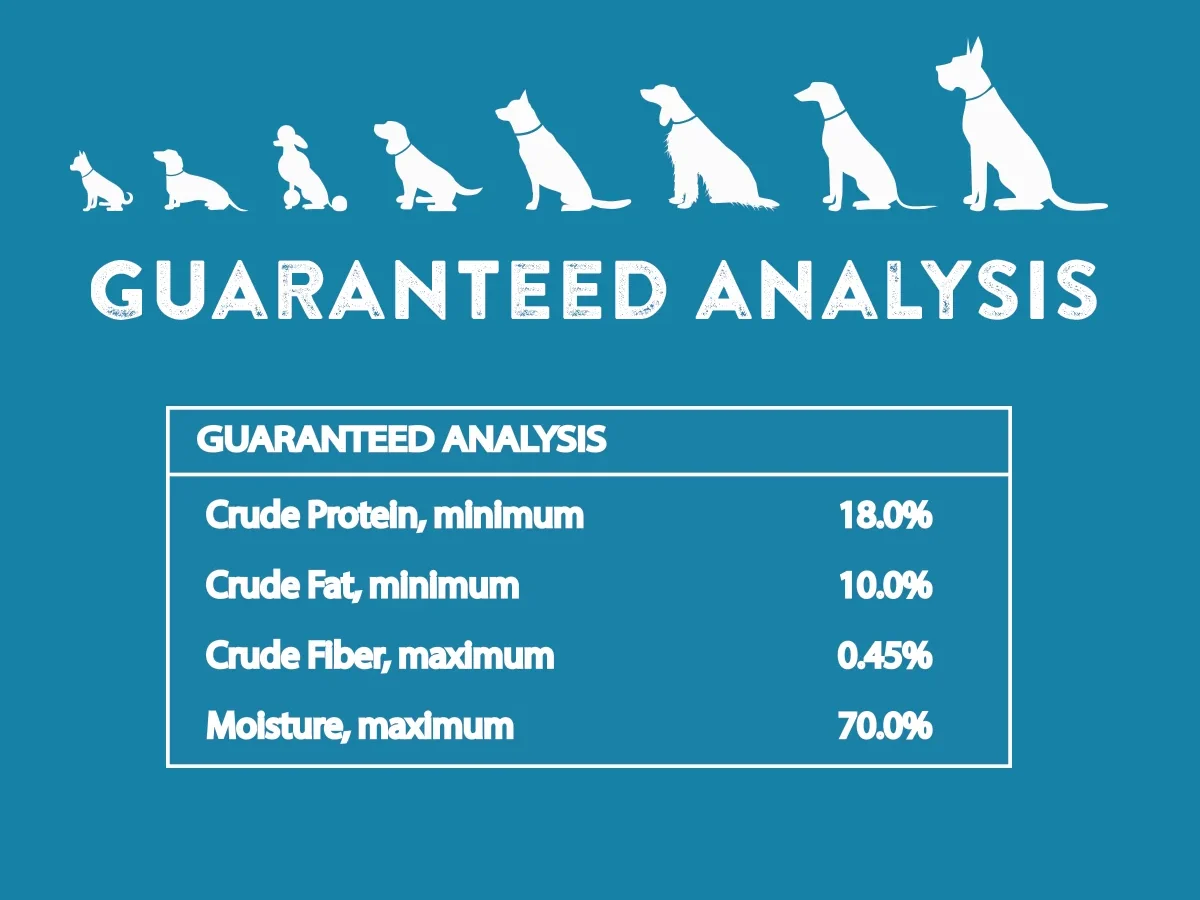
Guaranteed analysis is the section of a pet food label that provides guaranteed percentages for certain nutrients. In a typical dog or cat food, the basic guarantees are minimum crude protein, minimum crude fat, maximum crude fiber, and maximum moisture.
The word “guaranteed” matters. Protein and fat are generally expressed as minimum guarantees, while fiber and moisture are generally expressed as maximum guarantees. A guarantee therefore does not mean the food contains exactly that percentage.
For a broader introduction to reading a pet food label from start to finish, see How to Read a Pet Food Label.
What Do Protein, Fat, Fiber, and Moisture Actually Mean?
Crude protein is an analytical measure used to estimate the protein content of the food. It does not, by itself, tell you the quality of the protein, the amino-acid profile, digestibility, or whether the food is nutritionally complete.
Crude fat is also an analytical measure. A higher crude-fat number can indicate a more energy-dense food, but fat percentage alone does not tell you how many calories your pet will consume because feeding amount and moisture also matter.
Crude fiber is a measure related to the food’s less-digestible components. It is useful for label interpretation, but it is not a complete description of the food’s total carbohydrate or fiber profile.
Moisture tells you how much water is present in the food. This number becomes especially important when comparing wet and dry products.
Why “30% Protein” Does Not Mean What You Think
A number such as 30% crude protein describes the concentration of protein in the product as labeled. It does not mean that 30% of your pet’s body weight should be protein, and it does not tell you how many grams of protein your pet should eat each day.
The amount your pet actually consumes depends on how much food they eat. A food with a higher protein percentage can still provide a different daily protein intake from another food if the serving size, calorie density, or moisture content differs.
The Moisture Problem: As-Fed vs. Dry-Matter Basis
This is one of the most important concepts in guaranteed analysis.
Pet food guarantees are normally expressed on an as-fed basis, meaning the food is considered as it is sold, including its water. Nutrient profiles used for nutritional comparison are commonly expressed on a dry-matter basis, which removes the water from the comparison.
That means a protein percentage from a can of wet food cannot always be compared directly with the protein percentage printed on a bag of kibble.
To convert an as-fed percentage to a dry-matter percentage:
Dry-matter nutrient % = (as-fed nutrient % ÷ (100 − moisture %)) × 100
Example: Suppose a wet food contains 12% crude protein and 78% moisture. Its dry matter is 22%. The protein level on a dry-matter basis is 12 ÷ 22 × 100 = 54.5%.
That does not mean the wet food is “54.5% protein” as sold. It means that after removing water from the comparison, protein represents 54.5% of the remaining dry matter.
For an official worked example of this calculation, see FDA’s “Complete and Balanced” Pet Food guidance.
A Simple Example: Comparing Wet and Dry Food
| Product | Crude Protein | Moisture | Protein on Dry-Matter Basis |
| Wet food | 12% | 78% | 54.5% |
| Dry food | 30% | 10% | 33.3% |
Looking only at the label, the dry food appears to contain much more protein: 30% versus 12%. After accounting for moisture, the comparison reverses. This is why guaranteed-analysis numbers should be interpreted in context.
Minimum vs. Maximum: Why the Direction Matters
Not every number on a guaranteed analysis means “at least this much.” Protein and fat are commonly minimum guarantees. Fiber and moisture are commonly maximum guarantees.
So if a label says “Crude protein — 26% minimum,” the manufacturer is guaranteeing at least that percentage under the applicable labeling rules. If it says “Crude fiber — 5% maximum,” the guarantee is that fiber will not exceed that declared percentage.
This is another reason not to treat the four numbers as if they were exact laboratory results for every bag or can.
Guaranteed Analysis Is Not the Same as Nutritional Adequacy
A food can have an appealing protein and fat profile without necessarily being complete and balanced for a particular species and life stage.
The nutritional adequacy statement answers a different question: is the food formulated or substantiated to provide complete and balanced nutrition for the intended species and life stage? That statement is much more important than chasing one impressive number in the guaranteed analysis.
If you want to understand that distinction in the context of the whole label, see Reading a Dog Food Label.
For the regulatory explanation of “complete and balanced,” see FDA’s Complete and Balanced Pet Food guidance.
What Guaranteed Analysis Cannot Tell You
- It does not tell you the complete amino-acid profile or protein quality.
- It does not tell you the digestibility of the entire diet.
- It does not tell you the exact amount of every vitamin and mineral in the food.
- It does not tell you how many calories your individual pet needs.
- It does not tell you whether a food is appropriate for a particular medical condition.
- It does not turn one nutrient percentage into a complete quality score for the product.
Why Calories Belong Next to the Guaranteed Analysis
Two foods can have similar protein percentages but provide different amounts of energy per gram. That matters because your pet consumes nutrients through the amount of food they actually eat.
For example, a calorie-dense food may require a smaller serving than a less energy-dense food. Looking at protein percentage without considering calories can therefore give an incomplete picture of actual daily intake.
For a deeper look at how calories connect label numbers to feeding, see AAFCO’s Calorie Content guidance.
How to Read Guaranteed Analysis Without Overthinking It
- 1. Check the species and life stage the food is intended for.
- 2. Read the nutritional adequacy statement before judging the nutrient numbers.
- 3. Identify which guarantees are minimums and which are maximums.
- 4. Note the moisture percentage, especially when comparing wet and dry foods.
- 5. Convert to a dry-matter basis when products have substantially different moisture levels.
- 6. Look at calories to understand how nutrient concentration relates to actual intake.
- 7. Use the ingredient list for context rather than treating it as a simple quality score.
If you want to understand the ingredient list alongside these numbers, see Pet Food Ingredients.
The Bottom Line
Guaranteed analysis is useful—but only when you understand what the numbers represent.
Protein, fat, fiber, and moisture percentages are declared guarantees, not a complete nutritional report and not daily feeding targets. The biggest trap is comparing numbers without considering whether they are expressed on the same moisture basis.
The most reliable way to read a pet food label is to combine guaranteed analysis with the nutritional adequacy statement, calories, ingredient list, feeding directions, species, and life stage. No single number on the bag can tell you whether a food is “best.”
Authoritative External References
- For the required guaranteed-analysis components and how guarantees are expressed, see AAFCO — Reading Labels.
- For the dry-matter conversion method and an official worked example, see FDA — “Complete and Balanced” Pet Food.
- For how calorie content is calculated and interpreted alongside proximate analysis, see AAFCO — Calorie Content.