What the Moisture Content Actually Changes in the Body?

Moisture content is the variable most wet-vs-dry cat food discussions skip past — usually stopping at convenience, texture, price, or the simple claim that wet food contains more water. But moisture is not just a label number. It changes how much water a cat receives with each meal, how much it may need to obtain by drinking, how concentrated the urine may become, and how much food volume is required to deliver a given amount of energy.
This does not make wet food universally “better.” A complete and balanced food still has to meet the cat’s nutritional needs, and individual cats differ. The more useful question is: what does the moisture level change physiologically, and what does it not change?
1. Moisture Changes the Water Budget Before Your Cat Drinks
A cat’s daily water intake comes from more than the water bowl. Water is supplied by food, drinking, and a smaller amount produced by metabolism. This matters because wet and dry diets can provide very different amounts of water before a cat takes a single sip.
Wet cat foods commonly contain around 70–80% water, while dry foods are much lower in moisture. Cornell notes that canned food is typically at least 75% moisture and that wet food can contain up to about 80% water.
Imagine two foods simply for illustration:
- 100 g of a wet food at 78% moisture supplies about 78 g of water.
- 100 g of a dry food at 10% moisture supplies about 10 g of water.
The cat does not need to “drink” that water because it is already part of the meal. Cats eating high-moisture food may therefore drink less from the bowl without necessarily consuming less total water.
2. Drinking Less Does Not Automatically Mean Being Less Hydrated
This is one of the easiest points to misunderstand.
When dietary moisture rises, voluntary drinking often falls because the cat is receiving more water through food. What matters physiologically is total water intake, not simply how much disappears from the water bowl.
Research by Buckley et al. (2011), published in the British Journal of Nutrition, found that cats fed higher-moisture diets drank less from the water bowl but took in more total water overall. They also produced more urine with a lower specific gravity, meaning the urine was more dilute.
So a cat that drinks very little while eating wet food is not automatically dehydrated. Conversely, a cat eating dry food is not automatically dehydrated simply because it drinks more.
The better question is whether the cat is maintaining adequate hydration for its individual circumstances.
3. More Dietary Water Can Change the Urine
The clearest physiological downstream effect of higher water intake is often seen in urine.
When more water enters the body and is not needed immediately for other losses, the kidneys excrete the excess. In controlled feline studies, higher dietary moisture has been associated with greater urine volume and lower urine specific gravity—that is, more dilute urine.
This is important because urine concentration affects the environment in which urinary minerals and other solutes are present. Some research has found that increasing dietary water can reduce urinary concentration and, under specific study conditions, lower relative supersaturation for calcium oxalate.
But this needs to be interpreted carefully. A wet diet is not a treatment for kidney disease, bladder disease, or urinary stones, and moisture alone does not determine a cat’s urinary health. Diet composition, mineral balance, urine chemistry, disease status, medications, and individual biology all matter.
The practical takeaway is narrower: increasing water intake can change urine volume and concentration, which is one reason hydration is relevant to feline urinary health.
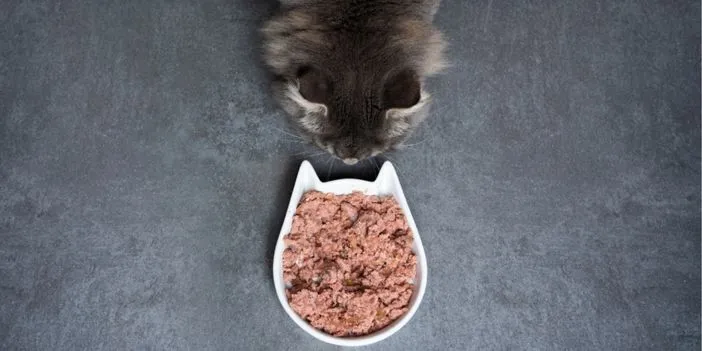
4. Moisture Also Changes How Much Food Volume Delivers the Same Calories
Water adds weight but no calories. As a result, increasing moisture usually lowers the energy density of a food unless the formulation changes in other ways.
This means two complete diets can deliver the same calories in very different physical amounts.
Illustrative example:
| Example | Wet food | Dry food |
| Energy density | 80 kcal / 100 g | 400 kcal / 100 g |
| Food needed for 200 kcal | 250 g | 50 g |
| Approx. water supplied | 195 g | 5 g |
This is an illustration, not a typical product specification. The point is that a higher-moisture food can deliver the same calories in a much larger physical portion.
This is one reason moisture can influence feeding experience and meal volume. A cat may receive a larger bowl of food without receiving more calories—provided the portions are adjusted by calories rather than by volume or weight alone.
This is also why switching between wet and dry food should not be done by simply replacing “one scoop” with “one scoop.” The calorie content per gram can be very different. For a practical guide to portioning by your cat’s needs, see
5. Why Wet Food Is Not Automatically Easier to Digest
A common assumption is that because wet food is soft and contains more water, it must be easier for the cat to digest.
That conclusion goes too far.
Moisture changes the physical form and water content of the meal, but digestibility depends on the complete formulation, ingredients, processing, nutrient composition, and the individual cat. A dry food can be highly digestible, and a wet food can vary widely in digestibility.
So it is better to say that moisture changes the meal’s physical characteristics and water delivery—not that it automatically determines digestive quality.
6. Moisture Changes the Meaning of Percentages on the Label
This connects directly to the label-reading skills developed earlier in the series.
A wet food might list 10% crude protein while a dry food lists 32%. Those percentages are reported on an as-fed basis, so the water in the product affects the apparent concentration.
For example, if a wet food contains 10% protein and 78% moisture, only 22% of the food is dry matter. The protein represents about 45.5% of the dry matter.
That does not mean the wet food is “45.5% protein” as sold. It means the water-free comparison looks different.
For the basic explanation of Guaranteed Analysis and dry-matter comparison, see What Is Guaranteed Analysis in Pet Food? A Simple Guide.
7. Moisture Is Not the Same Thing as Nutritional Adequacy
A high-moisture food can be nutritionally complete and balanced. A low-moisture food can also be nutritionally complete and balanced. For the broader nutritional foundation, see Essential Nutrients for Cats.
Moisture does not tell you whether a food provides the right nutrients in the right amounts and ratios for the intended life stage. AAFCO emphasizes the nutritional adequacy statement as a key part of evaluating whether a pet food is complete and balanced for a particular species and life stage.
So the order of questions matters:
- Is the food complete and balanced for the cat’s life stage?
- How many calories does it provide?
- How much moisture does it contain?
- How will that moisture affect the cat’s total water intake and feeding routine?
- Does the individual cat have medical or nutritional needs that change the decision?
Moisture is one variable in the system—not the entire definition of a good food.
8. What About Cats With Kidney or Urinary Problems?
This is where general nutrition advice needs a boundary.
For some cats with kidney, urinary, or other medical conditions, veterinarians may deliberately use diets or feeding strategies that change water intake, urine concentration, mineral intake, or other nutritional factors. But the appropriate strategy depends on the diagnosis.
It is not accurate to say that every cat with kidney disease should simply eat wet food, or that every healthy cat needs wet food to protect its kidneys.
If a cat has persistent changes in drinking or urination, repeated urinary problems, vomiting, poor appetite, weight loss, or a diagnosed kidney or urinary condition, food selection should be discussed with a veterinarian.
9. The Most Useful Way to Compare Wet and Dry Food
Instead of asking “Which is healthier?”, look at what changes when the format changes:
| Physiological variable | What moisture changes |
| Moisture | Changes the water supplied by the meal. |
| Total water intake | Reflects both water in food and water consumed by drinking. |
| Urine | Higher water intake can increase urine volume and reduce urine concentration. |
| Energy density | Usually falls as water content rises, all else equal. |
| Meal volume | The same calories may require a larger physical portion in a higher-moisture food. |
| Label percentages | As-fed percentages are harder to compare directly when moisture differs. |
| Digestibility | Depends on the whole formulation, not moisture alone. |
| Nutritional adequacy | Must be evaluated separately from moisture. |
10. What This Means in Real Life
For a healthy cat, a complete and balanced wet diet can be a practical way to provide more water through meals. A complete and balanced dry diet can also work, especially when the cat reliably drinks and the food fits the household routine.
Some cats do well with a combination of both. In mixed feeding, the important point is to account for the total daily calories rather than adding wet food on top of the usual dry-food amount.
The goal is not to make every cat eat the same format. The goal is to understand what the format changes inside the feeding system and then choose a routine that meets the cat’s nutritional and hydration needs.
Quick Summary
- Wet food contains much more water than dry food.
- Cats eating wetter diets may drink less because more water comes from food.
- Higher dietary moisture can increase total water intake and produce more dilute, higher-volume urine.
- More moisture usually means lower calorie density, so the same calories may require a larger food volume.
- Wet food is not automatically easier to digest; formulation matters more than texture alone.
- Moisture changes how Guaranteed Analysis percentages should be interpreted, but it does not determine nutritional adequacy.
- For cats with kidney or urinary disease, diet decisions should be individualized with veterinary guidance.
Sources: Buckley et al. (2011), British Journal of Nutrition; Thomas et al. (2017), Journal of Nutritional Science; Kosmal et al. (2026), Journal of Animal Science; Zanghi et al. (2018), American Journal of Veterinary Research; Cornell Feline Health Center; AAFCO; WSAVA Global Nutrition Committee.