Named Meat vs. Meat By-Products in Cat Food: Same Words, Higher Stakes

Meat by-products in cat food get a bad reputation they don’t always deserve. ‘Real meat’ often sounds automatically better — but for cats, that shortcut is especially misleading, because cats have specific nutritional requirements and the finished diet must supply the right nutrients in the right amounts.
Named meat and meat by-products are different ingredient categories. Neither phrase, by itself, tells you whether a cat food is nutritionally complete, digestible, appropriate for a life stage, or well formulated.
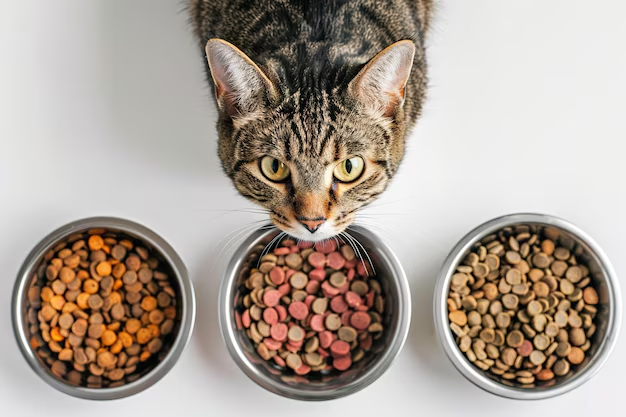
What “Named Meat” Means
On a cat food label, a named meat ingredient identifies an animal source and generally refers to muscle tissue. AAFCO defines meat primarily as clean flesh from slaughtered mammals, while poultry and fish have their own terminology.
The important point is that “meat” is a defined ingredient term, not simply a marketing word. Ingredient names tell you something about the material being used, but they do not tell you the entire nutritional quality of the finished food.
Before judging an ingredient, it helps to understand what makes a cat diet nutritionally different in the first place. Our Essential Nutrients Cats Need That Dogs Don’t article explains the species-specific requirements behind that distinction.
What “Meat By-Products” Means
Meat by-products are clean, non-rendered parts of slaughtered mammals other than meat. They can include organs such as liver and kidneys, as well as other tissues and bone.
That matters for cats because organ tissues can contribute important nutrients. The fact that an ingredient is less familiar to humans does not automatically make it inferior for cats.
AAFCO also notes that animal-source ingredients can differ in nutrient composition, which is why the complete formulation matters more than one ingredient name.
Why By-Products Are Not Automatically “Bad” for Cats
The word “by-product” describes an ingredient category; it is not a quality score. AAFCO states that by-products can safely provide nutrition for animals.
A cat food can contain meat by-products and still be complete and balanced. Conversely, seeing a named meat near the top of an ingredient list does not by itself prove that a food meets every nutritional requirement a cat has.
That is why our Reading Cat Food Labels guide puts nutritional adequacy ahead of ingredient-name anxiety.
Why Cats Make This Question More Important
Cats are obligate carnivores with specific nutrient requirements that differ from dogs. They need nutrients such as taurine and preformed vitamin A, and their diet must provide appropriate amino acids, fatty acids, vitamins, and minerals.
The same principle applies when deciding how much and how often to feed: the food choice is only one part of the nutritional picture. Our How Much Should You Really Feed Your Cat? guide explains why feeding amounts depend on the individual cat, not just the food label.
Fresh Meat vs. Rendered Meals
A fresh meat ingredient contains a lot of water. A rendered meal has been cooked and processed to remove much of the water and fat, leaving a more concentrated ingredient containing protein and minerals.
This means comparing “fresh chicken” with “chicken meal” purely by position on an ingredient list can be misleading. The two ingredients are not equivalent in moisture or concentration.
The ingredient’s name tells you something, but not everything.
Does a Meat-First Cat Food Automatically Win?
No. Ingredients are listed in descending order by weight. Because fresh ingredients contain substantial water, their position does not tell you the exact amount of dry matter or nutrients they contribute to the finished food.
A better evaluation combines the ingredient list with the nutritional adequacy statement, guaranteed analysis, calorie information, life-stage suitability, and the manufacturer’s formulation and quality-control practices.
What About Organs?
Organs are often included within discussions of by-products, but “organ” does not mean “waste.” Liver, kidneys, and other tissues can be nutrient-rich animal ingredients.
The important issue is balance. More of a nutrient is not always better, and a complete cat food must provide nutrients in appropriate quantities rather than simply maximizing one attractive ingredient category.
This becomes especially relevant as cats age, when protein, calories, body condition, muscle condition, and diagnosed disease may need to be considered together. Our Senior Cats: How Nutritional Needs Change as Kidney and Metabolic Health Shift article explores that individual approach.
A Better Way to Read a Cat Food Label
Instead of asking whether a label sounds premium, work through these questions:
• Is the food complete and balanced for my cat’s life stage?
• Are animal-source ingredients present among the major ingredients?
• What do the guaranteed analysis and calorie information show?
• Does the food fit my cat’s age, body condition, activity, and health needs?
• Is the manufacturer transparent about formulation and quality control?
Ingredient lists are useful, but they are one part of the evaluation—not the whole verdict.
The Bottom Line
Named meat and meat by-products are different ingredient categories. For cats, the bigger mistake is assuming that one category automatically guarantees better nutrition.
By-products can include nutrient-rich organs and other animal tissues. Fresh meat contains more water, while rendered meals are more concentrated. Ingredient order therefore needs context.
The strongest question is not “Does this label sound premium?” It is “Does this finished food provide complete and balanced nutrition for my cat?”