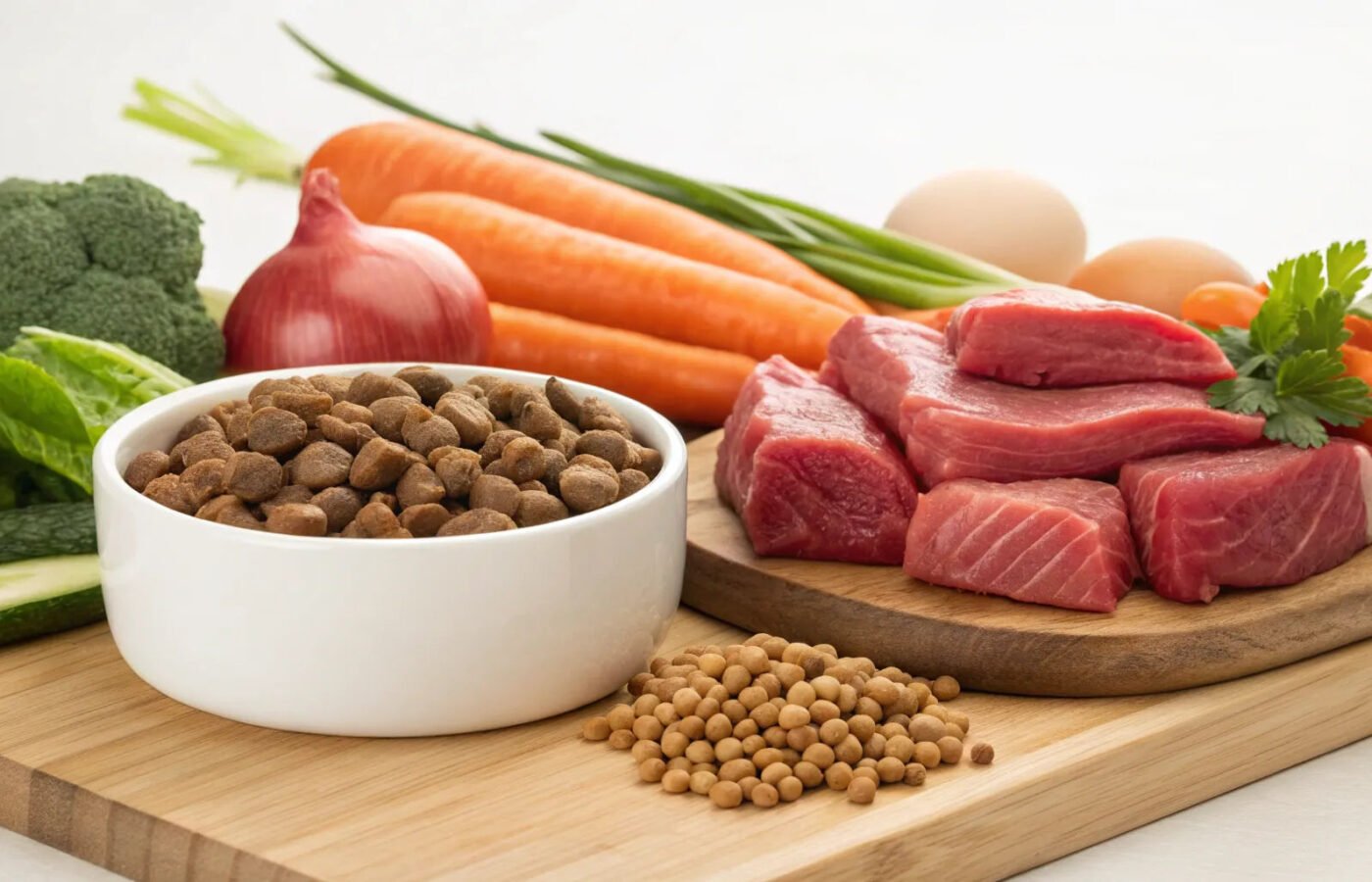
Protein Quality vs. Protein Quantity: Why “High Protein” Labels Can Mislead

A dog food can advertise a high protein percentage and still not tell you the whole story about its protein. Protein quantity matters, but so do the amino acids it provides, how well the protein is digested and used, the food’s overall formulation, calorie density, and the dog’s life stage and individual needs.
For a broader foundation, see our Dog Nutrition guide.
Why “High Protein” Is Not the Same as “Better Protein”
The guaranteed analysis tells you how much crude protein a food guarantees, usually as a minimum percentage. It does not directly tell you the protein’s amino acid profile, digestibility, or biological value.
Dogs need specific essential amino acids. A food therefore needs to provide those amino acids in appropriate amounts and proportions, not simply a large number on the protein line.
AAFCO treats guaranteed analysis and the ingredient list as different parts of the label: the ingredient list shows ingredients in descending order by weight, while guaranteed analysis gives guaranteed amounts of certain nutrients. Neither section alone is a complete measure of protein quality.
1. Protein Quantity: What the Label Actually Tells You
If a label says “Crude Protein — 30% min,” the 30% is a minimum guarantee, not necessarily the exact amount in every batch.
Protein percentage also needs context. Label guarantees are normally expressed on an as-fed basis, so moisture can make direct comparisons between wet and dry foods misleading.
For the mechanics of reading protein guarantees and dry-matter comparisons, see What Is Guaranteed Analysis in Pet Food?.
2. Protein Quality: What “Quality” Really Means
Protein quality is not one single number on a standard pet food label. It is better understood as a combination of factors that determine whether the protein supplies the amino acids a dog needs and how effectively those amino acids can be digested and used.
- Amino acid profile — whether the protein supplies essential amino acids in appropriate amounts.
- Digestibility — how much of the protein can be digested and absorbed.
- Bioavailability — how much of the absorbed amino acids can be used by the body.
- Overall formulation — whether the complete diet supplies the right balance of nutrients.
- Ingredient and processing characteristics — factors that can affect nutrient availability and digestibility.
This is why judging a food solely from the first ingredient or crude protein percentage can be too simplistic.
3. The Amino Acid Profile Matters More Than the Protein Number Alone
Dogs use amino acids to maintain tissues and support many normal physiological functions. Some essential amino acids must come from the diet.
A food containing 25% protein can therefore be nutritionally adequate, while a food containing more protein is not automatically superior simply because the number is higher. The complete diet must provide the required nutrients in appropriate amounts for its intended life stage.
For an overview of the nutrients dogs need, see What Dogs Need in Their Diet.
4. Animal Protein vs. Plant Protein: Avoid the Simple “Good vs. Bad” Rule
It is tempting to divide ingredients into “good animal protein” and “bad plant protein,” but nutrition is more complicated than that.
Different ingredients contribute different amino acids and nutrients. What matters is how they work together within the finished diet. A complete and balanced food can use a combination of animal and plant ingredients while still meeting the nutritional requirements established for its intended life stage.
Likewise, seeing a named meat as the first ingredient does not automatically prove superior protein quality. Ingredient lists are ordered by weight, and ingredients can contain very different amounts of water.
See 5 Essential Pet Food Ingredients for more context.
5. When More Protein May Matter
Protein needs are not identical for every dog. Life stage, activity, body condition, health status, and the purpose of the diet all matter.
- Growing puppies need diets formulated to support growth and development.
- Adult dogs need adequate protein to maintain tissues and normal body functions.
- Highly active or working dogs may have different energy and nutritional demands from sedentary dogs.
- Older dogs may need particular attention to maintaining muscle condition, but simply increasing protein is not automatically the correct response for every senior dog.
For life-stage differences, see [Best Dog Food for Different Life Stages].
6. Protein, Calories, and Body Condition Work Together
Protein is only one part of the diet. Calories matter because a dog can consume too much energy even when a food has an attractive protein percentage.
When comparing foods, consider protein together with calorie density, fat, feeding amount, life stage, and body condition. A higher-protein food is not necessarily better if it provides more calories than the dog needs or is otherwise inappropriate for the individual dog.
7. What to Look for Instead of a “High Protein” Claim
- Is the food complete and balanced for the dog’s species and life stage?
- Is the protein level appropriate for the individual dog?
- Are calories appropriate for activity and body condition?
- Are foods with different moisture levels being compared on a similar basis?
- Does the overall formulation provide required nutrients?
- Are you evaluating the whole diet rather than one ingredient or marketing claim?
WSAVA recommends individualized nutritional assessment rather than reducing food selection to one label characteristic. Veterinary guidance is especially useful when a dog has a medical condition or unusual nutritional needs.
A Simple Example
| Food A | Food B | |
| Crude protein | 30% min | 25% min |
| Calories | Higher | Moderate |
| Life stage | Adult maintenance | Adult maintenance |
| Nutritional adequacy | Complete and balanced | Complete and balanced |
Food A has the higher protein guarantee, but that does not make it automatically better. If both foods are nutritionally adequate, the appropriate choice depends on the individual dog, calorie needs, body condition, preferences, and the rest of the formulation.
The example illustrates the central point: protein quantity is useful information, but it is not a complete definition of protein quality.
Quick Takeaway
- High protein does not automatically mean higher-quality protein.
- Protein quality involves amino acids, digestibility, bioavailability, and overall formulation.
- Guaranteed analysis tells you the guaranteed protein level, not the full quality of that protein.
- Moisture and calorie density can make simple percentage comparisons misleading.
- Choose food based on complete and balanced nutrition and the individual dog’s needs—not one headline number.
Conclusion
Protein is essential, but “more” is not the same as “better.” A high-protein label can be useful information, yet it cannot tell you the full story about amino acid balance, digestibility, calorie density, or whether the food is appropriate for a particular dog.
The better question is not simply how much protein a food contains, but whether the complete diet provides the right nutrients, in appropriate amounts, for the dog that will eat it. For more practical nutrition guidance, explore our Dog Nutrition hub.