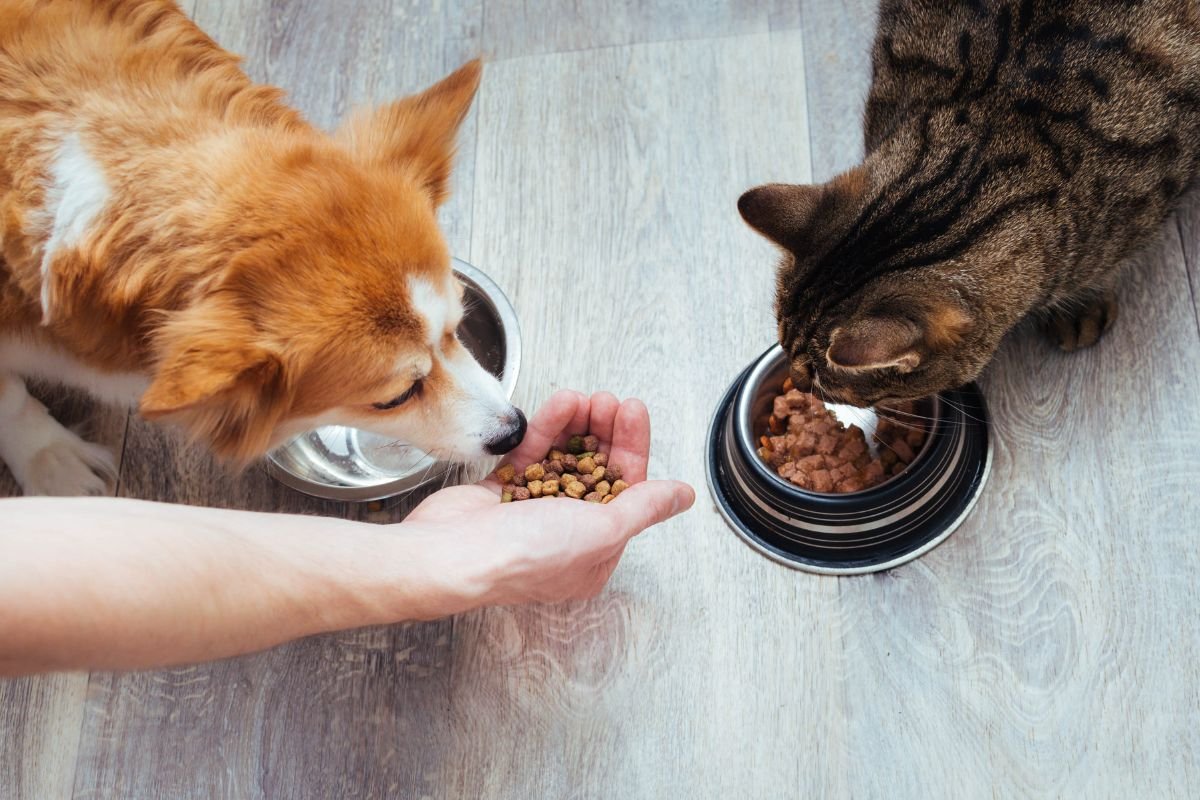
Feeding Dogs and Cats Differently Under One Roof: A Multi-Pet Household Guide

Feeding dogs and cats together under one roof can make mealtime more complicated than it looks. One pet may finish first and visit the other bowl. Another may graze slowly. One pet may finish first and visit the other bowl. Another may graze slowly. A dog may be highly motivated by food, while a cat may prefer to eat in a quiet location. If both pets can reach every bowl, it becomes difficult to know who actually ate what.
The goal is not to make the household feeding system complicated. It is to make each pet’s food, feeding location, and access rules clear enough that every animal can reliably eat its intended diet.
AAHA identifies food competition and pets eating another pet’s food as feeding-management problems and recommends options such as separate feeding, measured access, and automated or identification-based feeders when appropriate.
1. Start with the principle: each pet has its own nutritional plan
Dogs and cats do not have identical nutritional requirements. A food formulated for one species should not automatically be treated as an interchangeable meal for the other. In a multi-pet home, the practical goal is not to make both pets eat the same thing; it is to make it easy for each pet to consistently receive the food intended for it.
For the broader feeding routine behind this approach, see How to Properly Feed Your Pet.
2. The first problem to solve is food stealing
Food stealing can happen in either direction. A dog may finish its meal and eat from the cat’s bowl. A cat may snack on a dog’s food. One pet may also hover near the other during meals and create competition.
AAHA notes that access to another pet’s bowl can lead to one animal consuming calories intended for another and recommends feeding pets separately when this is a problem.
- Feed pets in separate rooms when practical.
- Use a closed door or baby gate if one pet repeatedly crosses over.
- Pick up bowls after meals if free access creates stealing.
- Consider an automated or identification-based feeder when pets need different access rules.
3. Not every pet needs the same feeding style
A shared home does not require a shared feeding method. The right setup may look different for each animal.
| Pet pattern | Possible setup | Why it can help |
| Fast eater | Measured meal in a separate space | Reduces opportunity to eat another pet’s food. |
| Slow/grazing cat | Protected feeding area or controlled-access feeder | Allows the cat to eat without another pet taking the food. |
| Food-motivated dog | Separate meals and controlled access | Reduces repeated bowl-checking and stealing. |
| Different diets | Clearly separated feeding locations | Makes accidental diet mixing less likely. |
4. Cats may need a quieter feeding environment
Cornell notes that heavy-traffic areas, noise, the presence of other animals, dirty food containers, or nearby litter boxes can discourage a cat from eating.
If a dog repeatedly approaches the cat while it eats, the issue may be the feeding environment rather than the food itself.
- Place the cat’s food in a calm, predictable area.
- Keep the feeding station away from litter boxes when possible.
- Avoid forcing a cat to eat beside a dog if the cat appears uncomfortable.
- Provide enough distance or physical separation for the cat to eat without interruption.
5. Multiple cats create a different set of problems
One cat may eat quickly, another may graze, and another may be reluctant to approach the bowl when another cat is nearby. Cornell notes that in multi-cat households, feeding cats separately or in different parts of the house may help when some cats miss meals or others overeat because food is always available.
The goal is not necessarily to isolate every cat all day. It is to create enough feeding access that one cat cannot consistently control another cat’s food.
6. Different foods require clearer boundaries
A multi-pet home becomes more complicated when animals need different diets—for example, different life-stage diets, different calorie targets, or a veterinarian-recommended therapeutic diet. Shared bowls or unrestricted access make it harder to follow the intended plan.
AAHA’s nutritional assessment framework treats feeding management and environmental factors—including separate bowls, competition, and access—as part of the overall nutrition assessment.
If you are also reviewing whether the food itself is complete and balanced, see What Is Guaranteed Analysis in Pet Food? .
7. Keep the routine simple enough to repeat
- Give each pet a clearly assigned feeding location.
- Keep feeding times predictable enough that everyone knows the routine.
- Control food according to each pet’s feeding plan.
- Keep treats and extras associated with the correct pet.
- Decide who is responsible for feeding so meals are not accidentally duplicated.
- Use a simple note or shared checklist if multiple people feed the pets.
8. Watch for signs that the system is not working
- One pet repeatedly reaches the other pet’s bowl.
- A pet regularly leaves food because another animal is watching or approaching.
- You cannot tell which pet ate how much.
- One pet is gaining or losing weight unexpectedly.
- A cat begins avoiding the feeding area.
- Meals become stressful, rushed, or competitive.
These signs do not automatically mean the food is wrong. They may indicate that the feeding environment or access rules need to change.
9. Wet and dry food can still be managed under one roof
There is no requirement for every pet in a household to eat the same food format. One pet may eat wet food while another eats dry food, provided each diet is appropriate for that individual animal.
For the cat-specific moisture question, see Wet vs. Dry Cat Food.
The practical issue is access. If a cat’s wet food is left available and the dog can reach it, the problem is uncontrolled access—not the wet format itself.
10. Food safety matters in a shared household
Multi-pet feeding means more bowls, scoops, containers, and leftovers to manage. FDA recommends washing hands before and after handling pet food, washing bowls and measuring utensils, promptly refrigerating or discarding unused canned or pouched food, and storing dry food appropriately.
A simple household rule is: each pet has its own bowl, bowls are cleaned regularly, and leftovers are handled according to the product’s storage instructions.
11. A simple system for feeding dogs and cats together
- Assign each pet a feeding location.
- Prepare each pet’s food separately.
- Feed at the planned time.
- Keep pets separated when necessary.
- Remove bowls when the meal is finished if free access causes stealing.
- Record unusual appetite, vomiting, diarrhea, or weight changes.
- Review the setup if one pet repeatedly interferes with another.
12. When feeding problems may need veterinary input
If a pet repeatedly refuses food, loses weight, vomits, develops persistent diarrhea, or shows other signs of illness, do not assume that better bowl placement will solve the problem.
A feeding-management change can solve competition and access problems, but it cannot diagnose an underlying medical condition. For cats in particular, prolonged refusal to eat warrants veterinary attention.
The real goal: separate access, not separate lives
Feeding dogs and cats together doesn’t mean feeding them the same way. Dogs and cats can share a home without sharing the same feeding routine. The most useful multi-pet system is usually not the most complicated one. It is the one that makes each pet’s food, feeding location, and access rules clear enough for the household to repeat every day.
Once each pet can reliably eat its intended diet without competition or accidental food sharing, nutrition becomes much easier to manage.
Medical boundary
This article provides general feeding-management information and does not diagnose appetite loss, food allergy, gastrointestinal disease, obesity, or other medical conditions. Persistent refusal to eat, unexplained weight change, repeated vomiting or diarrhea, pain, marked lethargy, or other concerning signs should be assessed by a veterinarian.
Scientific Sources / References
- AAHA. 2021 AAHA Nutrition and Weight Management Guidelines — Feeding Plans for Healthy, Appropriate Weight Cats and Dogs. https://www.aaha.org/resources/2021-aaha-nutrition-and-weight-management-guidelines/feeding-plans-for-healthy-appropriate-weight-cats-and-dogs/
- AAHA. Prevention of Obesity — feeding management and multi-pet food competition. https://www.aaha.org/resources/2021-aaha-nutrition-and-weight-management-guidelines/prevention-of-obesity/
- Cornell Feline Health Center. Feeding Your Cat. https://www.vet.cornell.edu/departments-centers-and-institutes/cornell-feline-health-center/health-information/feline-health-topics/feeding-your-cat
- Cornell Feline Health Center. How Often Should You Feed Your Cat? https://www.vet.cornell.edu/departments/cornell-feline-health-center/health-information/feline-health-topics/how-often-should-you-feed-your-cat
- FDA. Tips for Safe Handling of Pet Food and Treats. https://www.fda.gov/animal-veterinary/animal-health-literacy/tips-safe-handling-pet-food-and-treats